

A gentle breeze circles you. The sound of the wind rippling over the water calms you. You take one step, two, three, then you’re across the stone bridge – forcing you to slow down, be present and reflect on the nature and beauty that surrounds you. You arrive at the resting house, a simple yet elegant shelter providing a serene environment for reflection and introspection. This is The Dawes Arboretum’s Japanese Garden.
In honor of 250 years since 1776, the Ohio Commission for the U.S. Semiquincentennial (America 250) has chosen a different theme each month to highlight and celebrate Ohio's rich history. For the month of Ohio’s Firsts and Originals, read about our Japanese Garden and the woman who takes care of it.
Designed in 1963 by Makoto Nakamura, it was one of the first of its kind in Ohio, and the only one Nakamura designed outside of Japan. It is a combination of three styles of Japanese Garden design: hill and pond garden, dry garden and stroll garden. It is attended by devoted staff like Shannon Barnette.
Shannon Barnette, Horticulture Manager at The Arboretum, began taking care of the Japanese Garden when she joined the Dawes’ team in 2022. Learning the design principles to best honor a Japanese garden is something Shannon has jokingly called a “trial-by-fire.”
She started to learn about the garden through plant palettes, similar to that of an artist. She discovered how the design principles of a Japanese garden diverged from traditional Western gardening and the role texture and forms played in creating a sense of harmony with nature. Throughout her time working on seasonal plantings and maintenance, she would plug in her headphones and listen to Japanese instrumental music while ranking the karensansui to create zen moments herself in the practice.
One of Nakamura’s wishes was to increase plant matter, which is why Shannon has spent the last two years planting many perennial plants and trees including Japanese Maples. She is also excited to add more bamboo fencing, and stone lanterns, which are a quintessential piece of the Japanese gardens. She is preparing to take the landscape to the next level with cloud pruning, also known as Niwaki, a traditional Japanese technique that creates tranquil, living art within the garden by training trees and shrubs into sculptural, flowing shapes that resemble clouds.
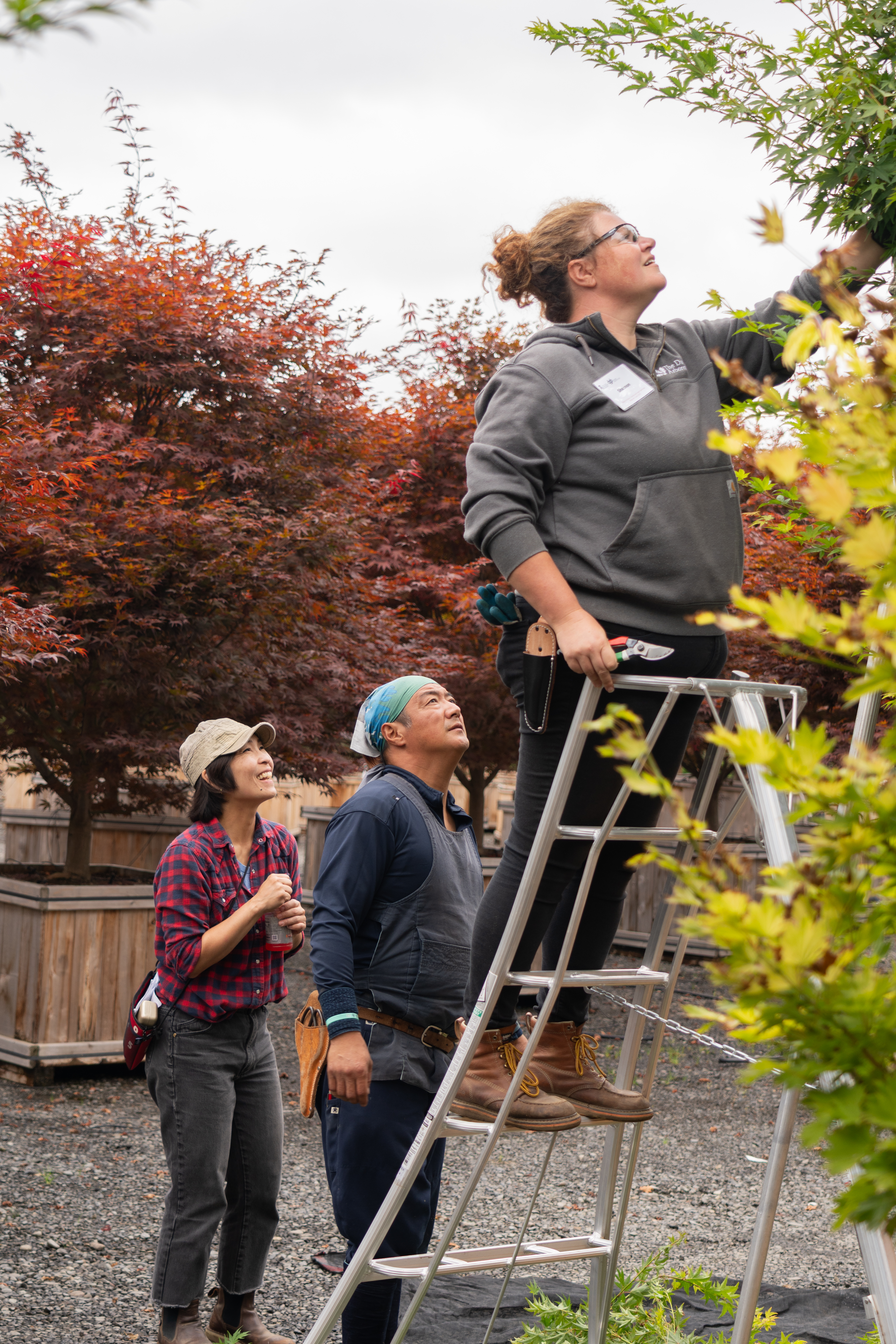 After two years of working with the Japanese Garden, she recently was given the opportunity to be among a select group of 12 who were invited to attend a 9-day training program in Portland, Oregon, at The Portland Japanese Garden. Among peers from Hawaii and England, she was provided with deep insights into everything from the history of Japanese gardens to the culture of tea, stone setting, stonework, bamboo fence building, traditional knot tying, proper plant selection and more.
The name of the program was ‘Waza to Kokoro’ which translates into hand and heart.
“Not only does it take the skill of being able to execute tasks, but you also have to have your heart in the work,” she said.
A lifelong learner, when her inbox buzzed with an email from the North American Japanese Gardening Association about a training intensive in Japan, she immediately blocked out the dates in her calendar as a manifestation that she would be granted the opportunity.
A week later, she was. Shannon’s passion, skill and experience showed her capability and she was invited to participate in the exclusive program to take place this spring.
She’s excited and nervous about traveling to another country and participating in such a unique program but feels honored for the opportunity.
She will experience garden excursions, management training, creation training, lectures and more. She says she is on 'cloud nine' – ecstatic about the opportunity to learn so much. She’s also beaming with joy that she’ll be there during the beauty of the cherry blossom season.
She’ll be traveling to the “Big 3” gardens of Japan: Kenroku-en in Kanazawa, Koraku-en in Okayama and Kairaku-en in Mito which are considered to represent the best elements of Japanese Gardens.
Grateful, eager and amazed at the beauty of an opportunity like this, Shannon is excited to bring back all she learns to The Arboretum and create a space that continues to give peace, joy and a sense of harmony to all who visit.
“Seeing that spark within your teams and you being able to teach that is amazing. Not everybody typically gets that opportunity in their landscape-based careers,” she says. “It’s been beautiful in multiple ways – it’s been an element of self-discovery that I was never anticipating.”
“The diversity of what we get to be exposed as employees, and the fact that we can share such a culturally significant element with the general public – there’s no better feeling.”