Aug. 21, 2026
As The Dawes Arboretum prepares to build its new, more accessible Welcome Center, many preparations are already being made. It’s important to note Staff have been very thoughtful about preserving as many trees as possible. The new driveway of the Welcome Center was intentionally designed to curve and meander around existing large trees so they can remain in place untouched.
For seven significant, healthy, larger trees that are directly in the path of construction, Dawes has invested in a special type of transplanting so they will be saved. They are carefully being air spaded and then moved to a secondary location in a woody plant research plot at Dawes.
In Spring of 2028 when the Welcome Center is finished, four trees will be relocated around the new center and three will go into the Japanese Garden. The Arboretum documented the journey of a Red Dragon European “Filbert” tree so its process could be shared.
“Filbert was selected specifically because we have very few of these cultivars in our collections and not another one of that size, structure, and value. This is the case for all the ones we are moving,” said Sam Klopfer, Land Manager at The Dawes Arboretum.
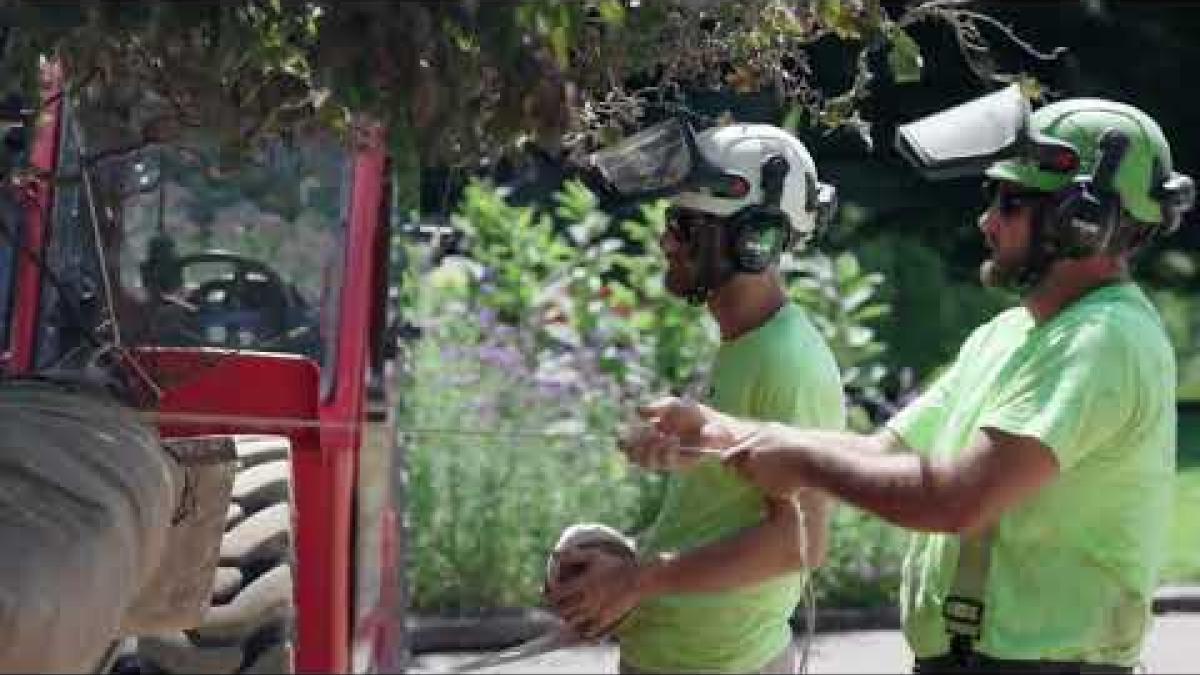
For just one large tree like Filbert, weeks of advance planning is necessary. Dawes staff worked with Andy Freeman, Ohio Tree MD, who has years of specialized training and experience with transplanting trees.
Freeman recently led the air spade method to remove Filbert, a specialized technique that has been around for two decades. Air spading uses high-pressure air to loosen compacted soil around the tree roots instead of shovels. This method helps improve tree health by allowing better access to air and water. This technique is a proven way to retain over 85% of the root mass versus the traditional way of hand digging, which results in losing more than 50% of the root mass.
Air spading a tree for transplant is the most effective way and not only saves more root mass, but the root ball is not as heavy to transport to its new location.
“The team at The Dawes Arboretum who is assisting in transplanting these trees are eager to learn, have a strong attention to detail, are respectful, hard workers and are consistently asking great questions. It is an honor and privilege to work with such fine individuals,” Freeman said.
Filbert needed the right large equipment to lift it out of the ground then move it to its new home. The new transplant site must be a good fit. An understanding of the species of tree is important. How fast does it grow each year – slow, medium or fast? This is important when considering how large the hole is and the soil condition where it’s replanted.
When a tree like Filbert is moved, the tree can become stressed. Filbert’s biggest challenge is moving from a protected, shaded environment to the temporary new location that is almost full sun. so that will be closely monitored by The Arboretum’s team.
The success rate on the tree is high if the proper protocol before, during and after the transplant process is followed. All trees, no matter what their size, need water before, during and after the process to survive. Some yellowing on the tips of leaves called dieback is possible and expected due to transplant shock, but if the aftercare program is followed precisely, the tree will remain healthy.
This process has been a wonderful opportunity for Dawes staff to learn new ways to maintain healthy trees.
“We chose to work with Andy (Ohio Tree MD) not only because of his experience doing these types of transplants and the meticulous level of care and preparation that goes into moving each of these trees, but also because of his experience as an educator. The goal has always been not just to save this group of trees to provide large plants for the new Welcome Center, but to facilitate our ability to bring this type of work in house and utilize the knowledge we've gained to move other plants when needed, while giving them the best chance of surviving the process.” said Klopfer.
The largest tree transplanted was a Kentucky Coffee Tree (Gymnocladus dioicus 'J.C. McDaniel' Prairie Titan), which is 20-25 feet tall and a diameter at breast height (DBH) of 12".
The other trees that will go through the same process are:
- Hedge Maple (Acer campestre 'Postelense')
- Hedge Maple (Acer campestre 'WFHhedge1' Hedge King)
- Japanese Maple (Acer palmatum (Dissectum Group) 'Pendulum Julian')
- Japanese Maple (Acer palmatum (Dissectum Group) 'Crimson Queen')
- Canadian Hemlock (Tsuga canadensis 'Cole's Prostrate')